





THE WEST BENGAL NURSING COUNCIL
Final Year General Nursing Midwifery (3 Years) Examination, May, 2024
Subject – Midwifery and Gynaecological Nursing
Paper-I
SUBJECTIVE
Full Marks – 75
Time Allowed – 3 Hours
Answer the following questions.
5. Mrs. Sunita Devi, a 27 years old pregnant women admitted in labour room with labour pain.
(a) Define Normal labour. 2 marks
Definition of Normal Labor Series of events that take place in the genital organs in an event to expel the viable products of conception that is the fetus, the placenta and the membranes out of the womb through the vagina into the external world is called labor.
Labor is called normal (Eutocia) if it fulfils the following criteria:
it is spontaneous in onset and at term;
it presents with vertex presentation;
it occurs without undue prolongation;
it has a natural termination with minimal aids;
and it occurs without having any complications affecting the health of the mother and/or the baby
(b) What are the stages of Normal labour? 3 marks
Stages of Normal Labor The events of labor are conventionally divided into the following stages:
• First stage: This starts from the onset of true labor pain and ends with full dilatation of the cervix. It has 3 phases:
i) latent phase: early labor with mild contraction and slow cervical dilatation. Dilatation 3/4cm rate 0.35cm/hr
ii) Active phase: Stronger contraction with rapid cervical dilatation: 4cm -8cm rate 1.2-1.5cm/hr
iii) Transition phase: Most intense phase just before full dilatation.
Total duration of first stage in primipara: 12hrs and Multipara 6 hrs.
• Second stage: This begins with the full dilatation of the cervix and ends with the expulsion of the fetus from the birth canal. It has two phases-
i) propulsive phase: Starts from full dilatation of cervix up to the descent of the presenting part to the pelvic floor.
ii) Expulsive phase: It is characterised by maternal bearing down efforts and ends with expulsion of fetus from the birth canal.
Total duration of second stage: primi 2 hrs, multipara: 30 minutes.
• Third stage: This begins after the expulsion of the fetus and ends with the expulsion of the placenta and membranes. Duration: 15 minutes.
• Fourth stage: This is a stage of observation for at least 2 hours after the expulsion of the placenta and membrane to monitor maternal vitals, uterine retraction, and vaginal bleeding to ensure the well-being of the mother and baby
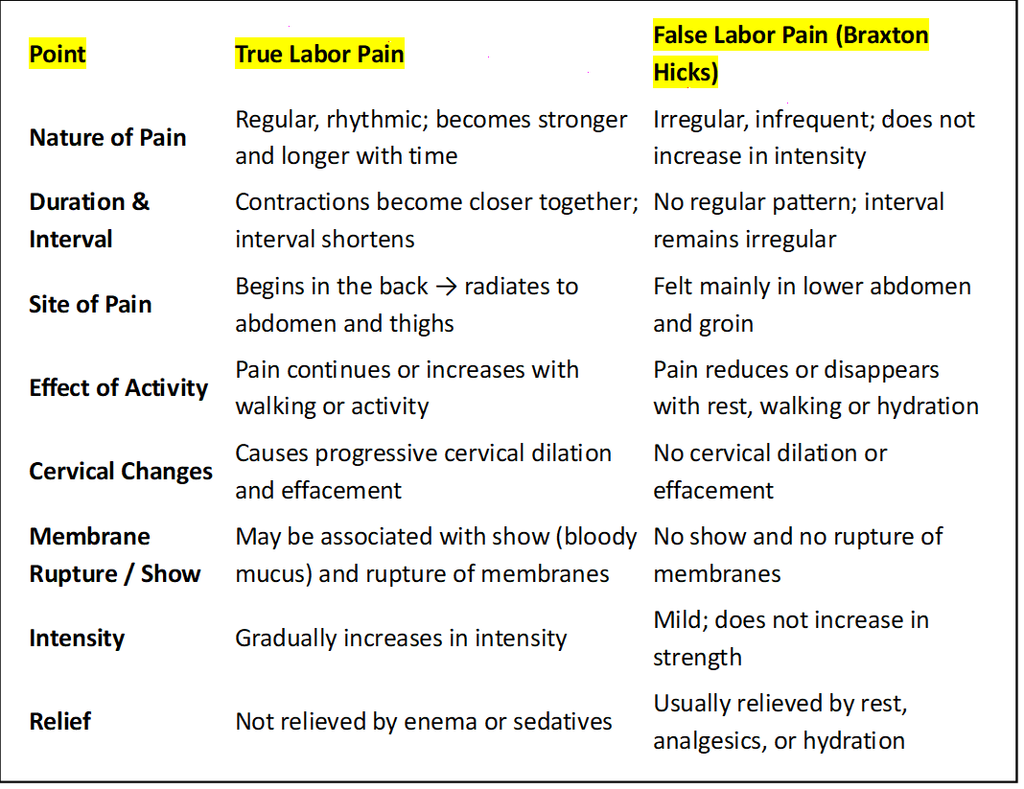
(c) Write down the difference between true labour pain & false labour pain. 4 marks
(d) Describe the management during first stage of labour. 6 marks
MANAGEMENT OF FIRST STAGE OF LABOR
The principles of management involve noninterference with watchful expectancy and careful monitoring of the progress of labor, maternal condition, and fetal behavior to detect complications early.
• General Management: Antiseptic dressing is performed, and the woman is given encouragement, emotional support, and constant supervision.
• Position and Ambulation: The woman may take a position comfortable to her but should avoid the dorsal supine position to prevent aortocaval compression. If membranes are intact, ambulation is allowed, which may reduce labor duration and the need for analgesia.
1. Maintenance of Energy (Diet)
Solid Foods: Food is generally withheld during active labor because there is delayed emptying of the stomach, which increases the risk of aspiration if general anesthesia becomes necessary unexpectedly. Fluids: To maintain hydration and energy, fluids such as plain water, ice chips, or fruit juice may be given in early labor.
Intravenous Fluids: An intravenous line with Ringer’s solution is often started if any intervention is anticipated or if the patient is under regional anesthesia to maintain hydration.
2. Relief of Pain
Analgesics: Common analgesic drugs used include pethidine (50–100 mg) or meperidine administered intramuscularly when pain is well established in the active phase. It may be repeated after 4 hours if necessary. Antiemetics like metoclopramide (10 mg) are often given to combat vomiting caused by pethidine. Regional Analgesia: Epidural analgesia is highly effective and is recommended if the woman requests pain relief, provided facilities are available.
Inhalation: Entonox (50% Nitrous Oxide + 50% Oxygen) may be used for pain relief during contractions.
3. Care of Bladder and Bowel
Bladder: The patient is encouraged to pass urine by herself approximately every 2 to 3 hours. A full bladder can inhibit uterine contractions and may lead to infection. If the patient fails to void urine, particularly in the late first stage, catheterization should be performed with strict aseptic precautions.
Bowel: The routine use of an enema is not recommended as it has been found that it neither shortens the duration of labor nor reduces the rate of infection.
Observation (Maternal and Fetal) Proper monitoring is essential to ensure the well-being of both the mother and the fetus and to track the progress of labor. These observations are typically recorded on a partograph.
Maternal Monitoring:
Pulse: Recorded every 30 minutes. Blood Pressure: Recorded every 1 hour. Temperature: Recorded every 2 hours. Urine Output: Recorded for volume, protein, or acetone.
Uterine Contractions: The frequency, intensity, and duration of contractions are assessed by abdominal palpation or tocodynamometer. The number of contractions in 10 minutes and the duration of each (mild <20 sec, moderate 20–60 sec, strong >60 sec) are recorded.
Fetal Monitoring:
Heart Rate: Fetal Heart Rate (FHR) is monitored every 30 minutes in the first stage. It should be counted for 60 seconds immediately following a uterine contraction. The normal rate ranges from 110 to 160 beats per minute. Progress of Labor:
Abdominal Examination: Assesses the descent of the fetal head in terms of fifths felt above the pelvic brim. Vaginal Examination: Performed periodically (e.g., every 4 hours or as indicated) to assess cervical dilatation (in cm) and the station of the head. It also checks the color of the liquor (if membranes are ruptured) and molding of the head.
Or.
A primigravida mother with 36 weeks pregnancy has been admitted in maternity ward with a history of oedema, hypertension and convulsion.
(a) What may be the possible diagnosis? 1 marks
The possible diagnosis is Eclampsia.
(b) Mention the clinical features of such condition. 5 marks
Clinical Features
Eclampsia is usually preceded by features of acute fulminating pre-eclampsia, known as premonitory symptoms, though it can occur abruptly.
Premonitory Symptoms (Severe Pre-eclampsia):
• Headache (occipital or frontal), disturbed sleep, and dimness of vision, blurred vision, photopsia, retinal detachment.
• Epigastric pain with vomiting (often due to hemorrhagic gastritis or subcapsular liver hematoma).
• Diminished urinary output (<400 mL in 24 hours), severe hypertension.
Stages of Eclamptic Convulsions (Fits): The seizures are epileptiform and consist of four distinct stages:
1. Premonitory Stage: The patient becomes unconscious. There is twitching of the face, tongue, and limbs. Eyeballs roll or turn to one side. This stage lasts about 30 seconds.
2. Tonic Stage: The whole body goes into a tonic spasm (trunk opisthotonus, limbs flexed, hands clenched). Respiration ceases, the tongue protrudes, and cyanosis appears. This stage lasts about 30 seconds.
3. Clonic Stage: Voluntary muscles undergo alternate contraction and relaxation. Twitching starts in the face and spreads to the whole body. Tongue biting occurs. Breathing is stertorous, and frothy, blood-stained secretions fill the mouth. This lasts 1–4 minutes.
4. Stage of Coma: Following the fit, the patient passes into a coma. This may last for a brief period, or deep coma may persist until another convulsion.
Post-Convulsion Status: Following convulsions, the temperature, pulse, respiration rate, and blood pressure usually rise. Urinary output diminishes, proteinuria is pronounced, and blood uric acid is raised.
(c) Write down the management of this mother. 9 marks
Eclampsia Management
The definitive treatment for eclampsia is the delivery of the fetus (termination of pregnancy). Management is divided into general/medical care and obstetric management.
A. General and Medical Management The principles are to control convulsions, stabilize vital functions, and maintain supportive therapy.
• First Aid/Supportive Care:
◦ Maintain airway and prevent injury (use a mouth gag to prevent tongue bite; raise bed rails).
◦ Position the patient in the left lateral decubitus position to avoid aspiration.Administer Oxygen (8–10 L/min).
◦ Start IV lines with wide-bore cannulas and insert a self-retaining catheter to monitor urine output.
• Anticonvulsant Therapy:
◦ Magnesium Sulfate () is the drug of choice. It acts as a membrane stabilizer and neuroprotector.
◦ Regimen: A loading dose of 4 g IV is given over 3–5 minutes, followed by 10 g IM (5 g in each buttock). Maintenance doses followed by 5g IM in each alternate buttocks every 4 hours.
◦ Monitoring: Before every repeat dose, ensure the presence of knee jerks, urine output >30 mL/hour, and respiratory rate >12-16/min to prevent toxicity.
◦ Antidote: Calcium gluconate (1 g IV) is used for magnesium toxicity.
• Antihypertensive Therapy:
◦ Indicated if BP remains >160/110 mm Hg to prevent cerebral hemorrhage.
◦ First-line drugs include Labetalol (IV) or Hydralazine (IV). Oral Nifedipine is also used.
• Fluid Balance: Crystalloids (Ringer’s solution) are preferred. Total fluids should not exceed the previous 24-hour urine output plus 1000 mL (roughly restricted to 2 liters in 24 hours) to prevent pulmonary edema.
B. Obstetric Management
• During Pregnancy:
◦ Fits Controlled: Once the mother is stable, delivery should be planned. If pregnancy is 34 weeks, delivery should be done. If the cervix is favourable, surgical induction (low rupture of membranes) is performed; if unfavourable, cesarean delivery is preferred.
◦ Fits Not Controlled: If fits are not controlled within 6–8 hours, termination of pregnancy is mandated regardless of fetal maturity. Cesarean section is indicated if the cervix is un favourable or vaginal delivery is not imminent.
• During Labor:
◦ Low rupture of membranes is done to accelerate labor.
◦ Oxytocin infusion may be added to augment labor.
◦ Prophylactic forceps or ventouse may be used to shorten the second stage.
• Postpartum:
◦ Magnesium sulfate should be continued for 24 hours after delivery or the last seizure
6.
(a) Define abortion. 2 marks
Abortion is defined as the expulsion or extraction from its mother of an embryo or fetus weighing 500 g or less when it is not capable of independent survival. This corresponds approximately to 22 weeks (154 days) of gestation. The expelled embryo or fetus is referred to as an abortus.
Termination of pregnancy before the viability of fetus.
(b) Classify abortion. 5 marks
Classification of Abortion
Abortion is broadly classified into two main categories: Spontaneous (Miscarriage) and Induced(deliberate)
Spontaneous Abortion (Miscarriage
This can be further divided into Isolated (sporadic) and Recurrent cases. The clinical types of spontaneous abortion include:
Threatened: The process of miscarriage has started but has not progressed to a state from which recovery is impossible.
Inevitable: It is the clinical type where the presence of bleeding, cervical dilation and abdominal pain indicates impending abortion.
Complete: When the products of conception are expelled en masse.
Incomplete: When the entire products of conception are not expelled instead a part of it is left inside uterine cavity.
Missed: When the fetus is dead and retained inside the uterus for a variable period, it is called missed miscarriage or early fetal demise.
Septic: Any abortion associated with clinical evidences of infection of the uterus and its contents.
Recurrent abortion: sequence of two or more spontaneous abortion.
B. Induced Abortion This category is divided into:
Legal: Medical Termination of Pregnancy (MTP).
Illegal (Unsafe): This is further categorized into Septic abortion.
(c) Write down the management of septic abortion. 4 marks
Management of septic abortion is guided by the severity of the infection (clinical grading) and focuses on controlling sepsis, removing the source of infection, and providing supportive care.
1. Initial Assessment and Clinical Grading
Management is tailored according to the extent of the infection:
Grade I: Infection is localized to the uterus.
Grade II: Infection has spread beyond the uterus to the parametrium, tubes, ovaries, or pelvic peritoneum.
Grade III: Generalized peritonitis, endotoxic shock, jaundice, or acute renal failure is present.
General Management Principles
Hospitalization and Isolation: All cases require admission, and the patient should be kept in isolation. Investigation:
Microbiology: High vaginal or cervical swabs must be taken prior to internal examination for aerobic/anaerobic culture, sensitivity, and Gram stain.
Imaging: Ultrasonography is used to detect retained products of conception, foreign bodies, or pelvic abscesses. X-rays may be used to detect bowel injury or gas under the diaphragm.
Labs: Routine blood work, coagulation profile, and serum lactate (to assess tissue hypoperfusion) are essential.
3. Antimicrobial Therapy
Since infections are often polymicrobial (mixed aerobic and anaerobic), broad-spectrum antibiotics are started empirically and adjusted based on sensitivity reports.
Preferred Regimens: A combination of piperacillin-tazobactam or carbapenem plus clindamycin (IV) provides broad coverage. Alternative Regimens: Gentamicin (3–5 mg/kg single dose) if renal function is normal. Metronidazole to cover anaerobes. Vancomycin may be added for Methicillin-Resistant Staphylococcus Aureus (MRSA). Tetanus Prophylaxis: Anti-tetanus serum (ATS) or booster should be given.
4.Surgical Management (Source Control) The approach depends on the clinical grade:
Grade I (Localized):
Evacuation of the Uterus: Since the abortion is often incomplete, evacuation should be performed within 24 hours of starting antibiotics. Early emptying removes the nidus of infection and minimizes bleeding risks. The procedure must be gentle to avoid uterine injury.
Grade II (Regional Spread):
Evacuation: Similar to Grade I, evacuation should be done early after the initial dose of antibiotics.
Posterior Colpotomy: If a pelvic abscess forms in the pouch of Douglas (indicated by spiky temperature, rectal tenesmus, and a boggy mass), drainage via posterior colpotomy is required to relieve symptoms.
Grade III (Generalized/Life-Threatening):
Laparotomy: This is indicated for suspected uterine injury, bowel injury, foreign bodies (intra-abdominal or intrauterine), unresponsive peritonitis (pus collection), or septic shock unresponsive to conservative measures. Procedure: A skilled surgeon should perform the operation. Hysterectomy is often required irrespective of parity to remove the septic focus. The abdomen, gut, and omentum must be thoroughly inspected for injury. Even if no specific injury is found, drainage of pus is effective.
5. Supportive and Intensive Care
Monitoring: Continuous monitoring of pulse, respiration, temperature, and urinary output is mandatory. In severe cases, Central Venous Pressure (CVP) monitoring is indicated (aiming for >8 mm Hg).
Fluid Resuscitation: Intravenous crystalloids and blood transfusions are administered to correct anemia, improve body resistance, and manage shock.
Complication Management: Septic/Endotoxic Shock: Requires intensive care, including circulatory support.
(d) Describe MTP Act. 4 marks
1. Definition: The MTP Act is a law that regulates the conditions under which pregnancy can be legally terminated in India to safeguard women’s health and reduce unsafe abortions.
2. Indications for MTP:
• Risk to mother’s life or physical/mental health
• Fetal abnormalities
• Pregnancy due to rape
• Failure of contraceptive methods (for married & unmarried women)
3. Gestational Age Limits (Amended 2021):
• Up to 20 weeks: Opinion of one registered medical practitioner (RMP).
• 20–24 weeks: Requires opinion of two RMPs, allowed for special categories (rape survivors, minors, differently-abled, disaster victims).
• Above 24 weeks: Allowed only for fetal anomalies approved by a Medical Board.
4. Who Can Perform MTP: Only a registered medical practitioner with training in MTP can perform the procedure in a government-approved or certified private center.
5. Methods of MTP:
• Up to 9 weeks: Medical method (Mifepristone + Misoprostol).
• 9–12 weeks: Suction and evacuation.
• 12–20+ weeks: Surgical evacuation/induction methods.
6. Consent Rules:
• Consent of the woman herself is mandatory (Form C).
• Husband’s or family’s consent not required.
• For minors/mentally ill women → guardian’s consent.
7. Confidentiality:
• Identity of the woman must not be disclosed.
8. Punishable Offences:
• Performing MTP in unapproved places
• Unqualified persons doing MTP
• Termination without proper indication or consent
7.
(a) Define healthy Newborn.
A healthy newborn is defined as an infant born at term (between 38 and 42 weeks) who has an average birth weight (usually exceeding 2,500 g), cries immediately following birth, establishes independent rhythmic respiration, and quickly adapts to the changed environment.
(b) What are the difference between healthy newborn with Preterm neonate?
| Feature | Healthy Term Newborn | Preterm Neonate |
| 1. Definition & Measurements | Born between 38–42 weeks of gestation. Usually weighs >2,500 g (mean 2.9 kg in India) with length 50–52 cm. | Born before 37 completed weeks of gestation. Usually weighs ≤2,500 g with length <44 cm. |
| 2. Skin & Subcutaneous Fat | Skin pink and coarse; lanugo sparse or absent. Subcutaneous fat well developed. | Skin thin, red, shiny with poor subcutaneous fat. Abundant lanugo and vernix caseosa. |
| 3. Head & Ears | Head circumference > chest by approx. 1.5 cm. Ear lobes firm with thick cartilage. | Head disproportionately large; skull bones soft with wide sutures. Ears soft, flat, and lack cartilage. |
| 4. Genitalia | Male: Testes fully descended; scrotum large with prominent rugae. Female: Labia majora cover labia minora and clitoris. | Male: Testes undescended; scrotum small with few rugae. Female: Labia minora prominent/exposed due to underdeveloped labia majora. |
| 5. Sole Creases | Entire sole covered with creases. | Before 34 weeks: no deep plantar creases; usually 1–2 transverse creases on anterior sole. |
| 6. Respiration | Establishes independent, rhythmic respiration immediately after birth. | Weak respiratory muscles, poor lung maturity; high risk of Respiratory Distress Syndrome (RDS). |
| 7. Muscle Tone | Good muscle tone, flexed posture. | Poor tone, hypotonia, limbs extended. |
(c) Write down the care of the baby in radiant warmer.
Care of Baby in Radiant Warmer
Care of a baby in a radiant warmer involves providing a controlled warm environment to maintain the newborn’s body temperature, prevent hypothermia, and support vital functions while allowing easy access for observation and medical procedures.
1. Immediate Placement and Setup:
◦ The radiant warmer should be preheated to before delivery to prevent cold stress immediately after birth.
◦ The baby should be dried immediately to prevent heat loss via evaporation and placed under the warmer.
The head should be covered with a pre-warmed towel to minimize heat loss from the large surface area.
2. Temperature Regulation (Servo-Control):
◦ The warmer should be operated in servo-control mode where a skin probe is attached to the infant’s abdomen.
◦ The goal is to maintain a normal skin temperature between 36.0 and 36.5 C.
This maintains a neutral thermal environment where oxygen consumption and metabolic rate are minimal.
3. Fluid Management:
◦ Neonates nursed under radiant heaters experience increased insensible water loss.
◦ To counterbalance this, the fluid requirement for these infants should be increased by 10%.
4. Special Care for Preterm Infants:
◦ For extremely low birth weight (ELBW) infants or those born <28 weeks, plastic bags or occlusive wrapping should be used under the warmer during stabilization to prevent evaporative heat loss.
◦ Consistent monitoring is required to prevent hypothermia, which can lead to complications such as hypoglycemia, metabolic acidosis, and hypoxia
8. Write short note (any three):
(a) PPIUCD
PPIUCD – Postpartum Intrauterine Contraceptive Device
Definition:
PPIUCD is an Intrauterine Contraceptive Device inserted within 48 hours after childbirth to provide immediate,
long-term, reversible contraception for postpartum women.
Timing of PPIUCD Insertion
- Post-placental: Within 10 minutes after delivery of the placenta.
- Immediate postpartum: Between 10 minutes – 48 hours after childbirth.
- During Cesarean section: Inserted directly into the uterine fundus before closure of the incision.
Types Used
- Copper IUCDs, mainly CuT 380A (effective for 10 years).
Eligibility Criteria
Hemodynamically stable postpartum woman.
No postpartum hemorrhage (PPH).
No infection (chorioamnionitis, PROM >18 hrs, puerperal sepsis).
No uterine abnormalities or active STI.
Advantages
Highly effective (>99%). Immediate contraception when women are highly receptive.
Safe during breastfeeding, Long-term (10 years) and reversible.
No effect on milk production. Convenient — avoids need for later visit.
Cost-effective family planning method.
Disadvantages / Side Effects
Cramping or abdominal discomfort. Irregular bleeding / spotting.
Rare expulsion (slightly higher than interval IUCD).
Very rare perforation or infection.
Contraindications
PPH or postpartum shock, Puerperal sepsis or chorioamnionitis
PROM >18 hours, Unresolved postpartum complications
Distorted uterine cavity, Severe anemia (relative)
Counseling Points
Explain benefits, risks, and reversibility.
Woman should check threads after 6 weeks.
Advise on warning signs (PAINS):
Pain lower abdomen Abnormal bleeding or discharge
Infection (fever, foul smell) No threads felt Suspected pregnancy
(b) Oxytocin
Oxytocin / Syntocinon
- Group name: Uterotonic drug
- Trade name: Pitocin, Syntocinon
- Mechanism of Action: It acts on myometrial receptors (which increase 100-200 fold during labor) to increase intracellular calcium, initiating physiological uterine contractions (fundal dominance with cervical relaxation).
- Indications:
- Pregnancy: Induction of abortion (inevitable/missed) or expulsion of hydatidiform mole.
- Labor: Induction of labor, cervical ripening, and augmentation of labor in uterine inertia.
- PPH management
- Puerperium: Active management of the third stage (AMTSL) and control of PPH.
- Diagnostic: Contraction Stress Test (CST).
- Administration: Induction of labor: 5IU IV in RL/NS AMTSL: 10IU IM, PPH: 20-40 IU IV in 1 L NS/RL
- Side Effects: Uterine hyperstimulation (tachysystole), uterine rupture (in obstructed labor or grand multipara), water intoxication (due to antidiuretic effect in high doses), and hypotension with bolus IV injection.
Contraindications: - Cephalopelvic disproportion (CPD), Malpresentation (breech, transverse lie), Placenta previa or vasa previa
Nurse’s Responsibilities
- Check baseline maternal vitals (BP, pulse, respirations) before administration.
- Monitor uterine contractions – frequency, duration, and intensity to prevent hyperstimulation.
- Assess fetal heart rate continuously using Doppler/CTG.
- Administer only via IV infusion pump (never IV bolus).
- Monitor for side effects: uterine hypertonicity, fetal distress, water intoxication.
- Document dose, route, response, maternal and fetal condition.
(c) KMC
KANGAROO MOTHER CARE (KMC)
Definition: A neonatal care method involving continuous skin-to-skin contact between mother
and low-birth-weight infant, exclusive breastfeeding, and early discharge with follow-up.
Indications: Birth weight <2500 g, preterm baby, stable LBW babies.
Components: It consists of three main components:
Kangaroo position, involving skin-to-skin contact between the mother and infant in a vertical frog like position;
Kangaroo nutrition, which emphasizes exclusive breastfeeding; and
Kangaroo discharge, allowing for early discharge from the neonatal unit
Benefits to Baby: Maintains temperature prevents cold stress, hypothermia; improves breastfeeding;
reduces infections; stabilizes respiration and heart rate; promotes weight gain;
reduces mortality and morbidity, promotes mother and child bonding.
Benefits to Mother: Enhances bonding; increases confidence in baby care; promotes early lactation; reduces stress.
Fastens involution, reduces pain, Improves milk production in mother.
Procedure: Place baby upright between mother’s breasts; secure with KMC binder; maintain
continuous contact as long as possible; monitor breathing, temperature, feeding, and activity.
Burping after each feed.
Duration: As long as mother and baby are comfortable; ideally 24 hours/day; minimum 1–2 hours/session.
continued till baby reaches 2500 g or maintains temperature independently.
Contraindications: Baby clinically unstable; mother severely ill.
Nursing Responsibilities: Encourage and assist mother, ensure proper position,
monitor baby’s temperature, respiration, color, and feeding, maintain privacy, educate family.
(d) Physiology of lactation
Physiology of Lactation
Lactation involves four distinct phases controlled by complex hormonal interactions.
Mammogenesis (Preparation of Breasts): During pregnancy, estrogen causes growth of ductal system, progesterone promotes lobulo-alveolar development, prolactin enlarges mammary glands and prepares for milk secretion. Some other hormones like HPL, insulin, thyroxin, cortisol also helps.
Lactogenesis (Synthesis and Secretion): Milk secretion usually starts on the 3rd or 4th postpartum day. Following delivery, the withdrawal of estrogen and progesterone allows prolactin to initiate milk secretion from the alveolar epithelium. Important hormones are prolactin, insulin, growth hormones and glucocorticoids.
Galactokinesis (Ejection of Milk): This is the discharge of milk, primarily driven by oxytocin. Suckling stimulates sensory nerves in the nipple, sending impulses to the hypothalamus to synthesize and transport oxytocin to the posterior pituitary. Oxytocin release causes contraction of myoepithelial cells around the alveoli and ducts, forcing milk down (the “let-down” reflex). Factors like pain or anxiety can inhibit this reflex.
Types of Milk:
• Colostrum: Thick yellow milk produced in first 2–3 days; rich in IgA, protein, WBCs; protects against infection.
• Transitional Milk: Produced from day 3 to 2 weeks; higher fat, lactose, and calories than colostrum; helps rapid growth.
• Mature Milk: Produced after 2 weeks; contains foremilk (watery, quenches thirst) and hindmilk (rich in fat, gives satiety and weight gain).
Galactopoiesis (Maintenance of Lactation): Prolactin is the key hormone for maintaining milk production. Frequent suckling is essential to maintain high prolactin levels and continuous lactation. Frequency of suckling >8 / 24hrs is essential.
(e) Antenatal diet
Antenatal Diet
An adequate antenatal diet is essential to maintain maternal health, support optimal fetal growth and development, provide physical strength during labor, and prepare the mother for successful lactation. The diet should ideally be light, nutritious, easily digestible, and rich in proteins, essential minerals, and vitamins.
1. Energy & Caloric Requirements
- Caloric Increase: During the second half of pregnancy, maternal basal metabolic rate (BMR) and tissue expansion increase energy demands. An additional 300 kcal/day over the non-pregnant baseline is required, bringing the total daily intake to approximately 2,500 kcal/day.
2. Target Weight Gain based on Pre-Pregnancy BMI
Maternal weight gain should be monitored regularly to prevent both fetal macrosomia and growth restriction:
- Normal BMI (18.5–24.9 kg/m²): Target weight gain is 11–16 kg (approx. 25–35 lbs).
- Underweight (<18.5 kg/m²): Target weight gain is 12.5–18 kg (28–40 lbs).
- Overweight (25.0–29.9 kg/m²): Target weight gain is restricted to 7–11.5 kg (15–25 lbs).
Obese (≥30 kg/m²): Weight gain should be limited to 5–9 kg (11–20 lbs).
Quality: The diet should be light, nutritious, easily digestible, and rich in protein, minerals, and vitamins.Composition: The diet should include at least half to one liter of milk, plenty of green vegetables, and fruits. At least half of the total protein should be first-class (animal) protein.
3. Essential Dietary Components & Daily Requirements
| Nutrient | Non-Pregnant Allowance | Antenatal Allowance (2nd Half) | Key Functions & Sources |
| Proteins | 50 g/day | 71 g/day | Essential for fetal growth and maternal tissue enlargement. At least half should be first-class protein (meat, fish, poultry, eggs, dairy). |
| Calcium | 500 mg/day | 1,000 mg/day | Crucial for fetal skeletal mineralization (80% transferred in 3rd trimester). Consuming 0.5–1 L of milk daily provides ~1 g of calcium. |
| Iron | 18 mg/day | 40 mg/day | Total demand is ~1,000 mg. Required for expanding red cell volume and fetoplacental unit. Diet alone is inadequate; routine supplementation is needed. |
| Folic Acid | 400 µg/day | 600 µg/day | Prevents megaloblastic anemia and reduces neural tube defects (NTDs). Preconceptional intake (0.4–5 mg) is recommended. |
| Iodine | 150 µg/day | 220 µg/day | Prevents fetal hypothyroidism and neurological deficits. Supplied via iodized salt and seafood. |
4. Supplementary Nutritional Therapy
- Iron & Folic Acid Supplementation: Since dietary iron is insufficient to meet daily demands during late pregnancy, routine oral iron supplementation (e.g., 1 tablet containing 60 mg elemental iron and 1 mg folic acid daily) is instituted for all mothers from 16 weeks of gestation onwards.
- Vitamins: Supplementary vitamins (A, D, C, and B-complex) are added from the 20th week to compensate for cooking losses.
- Hydration: Drink 8–10 glasses of safe water daily. Coconut water, lemon water, soups are beneficial.
- Avoid harmful foods: Excess tea/coffee, spicy/junk food, soft drinks, raw meat, unpasteurized milk, alcohol, tobacco, and smoking.
5. Practical Dietary Advice
- Meal Pattern: Meals should be taken in small, frequent portions rather than large single meals to alleviate acidity and heartburn caused by progesterone-induced esophageal relaxation.
- Fluid Intake: Plentiful fluids, fruits, and green leafy vegetables are recommended to promote regular bowel movements and reduce constipation.
- Nausea & Morning Sickness: Eating dry toast or biscuits before rising and avoiding greasy/spicy foods help alleviate early morning nausea.
- Salt Intake: Routine salt restriction is not recommended unless indicated for underlying pre-existing medical conditions.


What do you think?
It is nice to know your opinion. Leave a comment.